The way people experience websites has changed significantly. Today, users expect websites to be fast, responsive, secure, and visually engaging across desktops, smartphones, tablets, and other digital platforms.
Traditional WordPress websites are still an excellent choice for many businesses, but Headless WordPress has become an increasingly attractive solution for modern websites that require greater flexibility and performance.
What Is Headless WordPress?
In a traditional WordPress website, WordPress manages both the content and the website’s frontend.
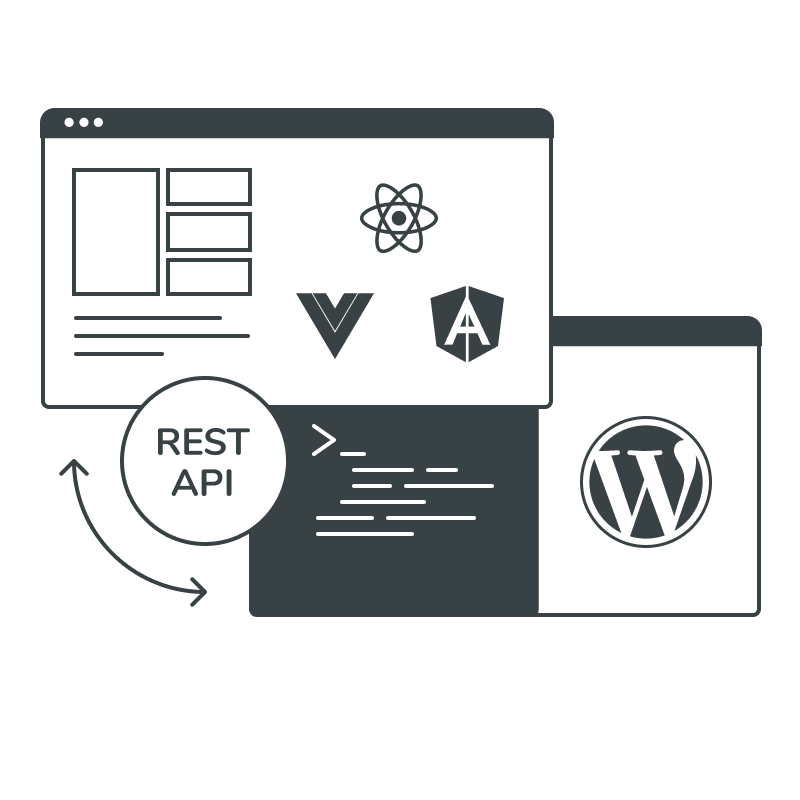
With a headless setup, WordPress is used primarily as a content management system (CMS), while the frontend is built separately using modern technologies such as Next.js, React, Vue, or other frameworks.
WordPress manages the content, while the frontend application retrieves that content through APIs such as the WordPress REST API or GraphQL.
This separation gives developers much greater control over how content is presented to users.
1. Faster Website Performance
Website speed is extremely important in the current digital environment. Users expect pages to load quickly, and slow websites can negatively affect both user experience and conversions.
Headless WordPress allows developers to use modern frontend technologies such as Next.js to optimize rendering, caching, image delivery, and page loading.
With techniques such as static generation, server-side rendering, and intelligent caching, websites can achieve excellent performance.
2. Better User Experience
A headless architecture provides developers with complete control over the frontend.
Instead of being restricted by a WordPress theme, developers can create custom interfaces and interactions specifically for the project.
This makes it easier to build modern experiences with smooth animations, interactive components, dynamic content, and highly customized layouts.
3. Modern Technology Stack
One of the biggest advantages of headless WordPress is that developers are not limited to WordPress’s traditional frontend architecture.
For example, a company can use:
- WordPress for content management
- Next.js for the frontend
- React for interactive components
- REST API or GraphQL for communication
- CDN and cloud services for performance and scalability
This allows businesses to combine WordPress’s powerful CMS capabilities with modern web development technologies.
4. Flexible Content Management
Content editors can continue using the familiar WordPress dashboard to create and manage pages, blogs, portfolios, products, and other content.
At the same time, developers have complete freedom over how that content is displayed on the frontend.
This creates a useful separation between content management and presentation.
5. Improved Scalability
Modern websites often need to handle traffic spikes, marketing campaigns, large content libraries, and growing numbers of users.
A headless architecture can make it easier to scale the frontend independently from the CMS.
For example, the frontend can be deployed through platforms and infrastructure designed for high performance while WordPress continues to operate as the content management backend.
6. Multiple Platforms From One CMS
Headless WordPress is not limited to websites.
The same WordPress content can potentially be delivered to multiple platforms through APIs, including:
- Websites
- Mobile applications
- Digital displays
- Web applications
- Other digital experiences
This makes headless WordPress particularly useful for organizations that want to manage content centrally while distributing it across multiple channels.
7. Strong Developer Flexibility
Developers have significantly more freedom when building a headless website.
They can select the frontend framework, component architecture, hosting environment, APIs, database integrations, and other technologies based on the project’s requirements.
This is especially useful for websites that need functionality beyond what traditional WordPress themes and plugins can easily provide.
8. Better Security Separation
A headless architecture can reduce the direct exposure of WordPress to website visitors because the public-facing frontend and WordPress backend can operate separately.
However, headless WordPress does not automatically make a website secure. Proper authentication, API protection, WordPress updates, server security, and access controls are still essential.
9. Excellent for Modern Business Websites
Headless WordPress can be particularly valuable for:
- Corporate websites
- Large portfolio websites
- News and publishing platforms
- High-traffic websites
- SaaS marketing websites
- E-commerce platforms
- Agencies
- Websites requiring highly customized frontend experiences
For a simple brochure website, traditional WordPress may still be the better and more cost-effective solution.
10. The Future of Flexible Web Development
Modern web development is increasingly moving toward architectures where the CMS, frontend, APIs, and infrastructure can work independently.
Headless WordPress fits well into this approach because it combines the simplicity of WordPress content management with the flexibility of modern frontend frameworks.
Conclusion
Headless WordPress is not simply a newer version of WordPress—it is a different approach to building websites.
For businesses that need high performance, modern user experiences, flexible frontend development, and the familiar WordPress content management system, headless WordPress can be a powerful solution.
However, it also requires more development knowledge and maintenance than a traditional WordPress website. The right choice ultimately depends on the project’s goals, budget, complexity, and expected growth.
For the current web development landscape, WordPress + Next.js is an especially powerful combination, bringing together an easy-to-use CMS with a modern, performance-focused frontend.
Leave a Reply