Not every website needs a complex technology stack. For many businesses, organizations, and individuals, the most important requirements are simple: a website should be reliable, affordable, easy to maintain, and capable of doing the job efficiently.
This is where PHP remains a practical choice. PHP has been powering websites for decades and continues to be widely used for business websites, blogs, portals, and custom web applications.
1. Cost-Effective Development
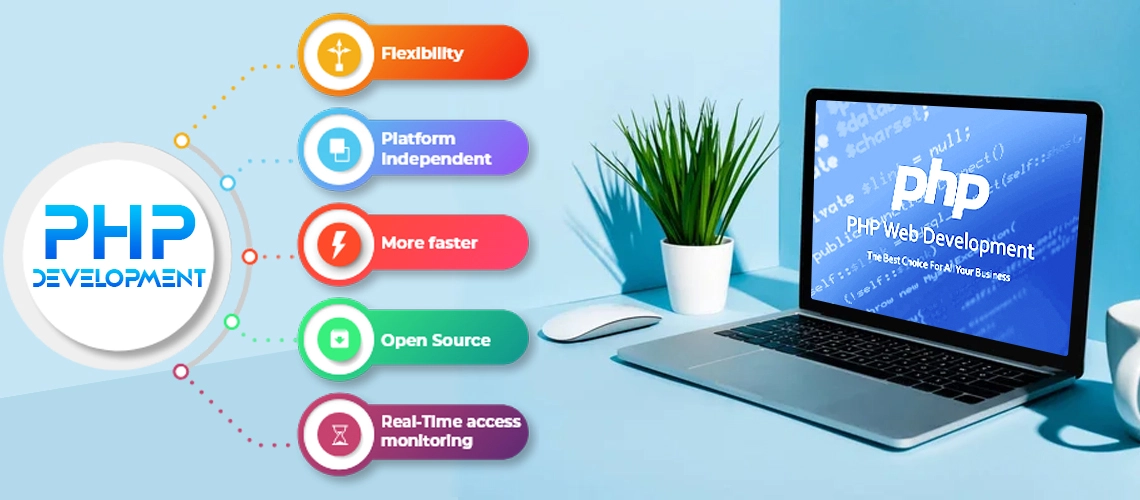
One of the biggest advantages of PHP is its affordability. PHP is an open-source technology, so there are no expensive licensing fees required to build a PHP website.
There are also many affordable hosting providers that support PHP, making the overall cost of running a PHP website relatively low.
For small businesses and startups working with a limited budget, this can make PHP an excellent option.
2. Easier to Develop
PHP is relatively straightforward to develop compared with more complex modern application architectures.
For websites with standard requirements such as:
- Business pages
- Contact forms
- Blogs
- Service pages
- Portfolios
- Admin panels
- Customer inquiry systems
PHP can provide everything needed without introducing unnecessary complexity.
3. Affordable Hosting
PHP websites can run on many affordable hosting environments, including traditional shared hosting and cPanel-based servers.
You often don’t need a separate application server or complex deployment infrastructure. This can significantly reduce hosting and maintenance costs.
4. Easy Maintenance
A simple PHP website can be easier to maintain because the application architecture can remain relatively straightforward.
Developers can update content, modify functionality, fix bugs, and add features without managing a complicated frontend-backend architecture.
For businesses that don’t have a dedicated technical team, simplicity can be a major advantage.
5. Huge Ecosystem
PHP has a large ecosystem of frameworks, libraries, CMS platforms, plugins, and development tools.
Popular platforms such as WordPress are built with PHP, while frameworks such as Laravel provide powerful tools for building custom web applications.
This means businesses can choose between a ready-made CMS and a fully customized application depending on their requirements.
6. Excellent for Small and Medium-Sized Websites
A PHP website is often more than enough for websites such as:
- Company websites
- Portfolio websites
- Restaurant websites
- Construction websites
- Agency websites
- School websites
- Local business websites
- Blogs
- Landing pages
For these types of projects, using a complex architecture may provide little practical benefit compared with a well-built PHP application.
7. Faster Development Means Lower Cost
Because PHP has mature tools, frameworks, CMS platforms, and hosting support, developers can often build websites quickly.
Less development time can mean a lower project cost for the client.
For example, a simple business website may not need a separate frontend application, API layer, and dedicated backend infrastructure. A traditional PHP application can handle everything in one system.
8. Easy Deployment
PHP applications are supported by a large number of hosting environments.
Deployment can be as simple as uploading the application files, configuring the database, and setting the required environment variables.
This makes PHP particularly convenient for clients who already use shared hosting or cPanel.
9. Reliable and Mature Technology
PHP has been used in web development for many years and has a mature ecosystem.
Its long history means there are plenty of developers, documentation, libraries, hosting providers, and solutions available when problems occur.
Businesses don’t have to depend on a new or experimental technology to build a reliable website.
10. Not Every Website Needs Headless or Modern JavaScript
Technologies such as Next.js and headless WordPress are excellent for projects that require advanced performance, highly interactive interfaces, or complex architectures.
However, they can also introduce additional development and infrastructure requirements.
For a simple website, a traditional PHP application may be the more sensible choice.
The best technology isn’t always the most advanced technology. It is the technology that matches the project’s actual requirements.
PHP vs. Modern Headless Architecture
| Requirement | Traditional PHP | Headless + Next.js |
|---|---|---|
| Development cost | Lower | Higher |
| Hosting cost | Usually lower | Can be higher |
| Deployment | Simple | More complex |
| Maintenance | Easier for simple sites | Requires more technical knowledge |
| Development speed | Fast for standard websites | More setup required |
| Custom frontend | Good | Excellent |
| Complex applications | Good with frameworks | Excellent |
| Simple business website | Excellent choice | Often unnecessary |
| Large-scale applications | Possible | Excellent choice |
Conclusion
PHP remains a strong choice for businesses that want a simple, affordable, reliable, and easy-to-maintain website.
While modern technologies such as Next.js and headless WordPress provide significant advantages for complex projects, they are not necessary for every website.
For a small business, portfolio, blog, or informational website, a well-developed PHP application can deliver everything the client needs while keeping development, hosting, and maintenance costs under control.
Choose technology based on your requirements—not simply because it is newer.
Leave a Reply